
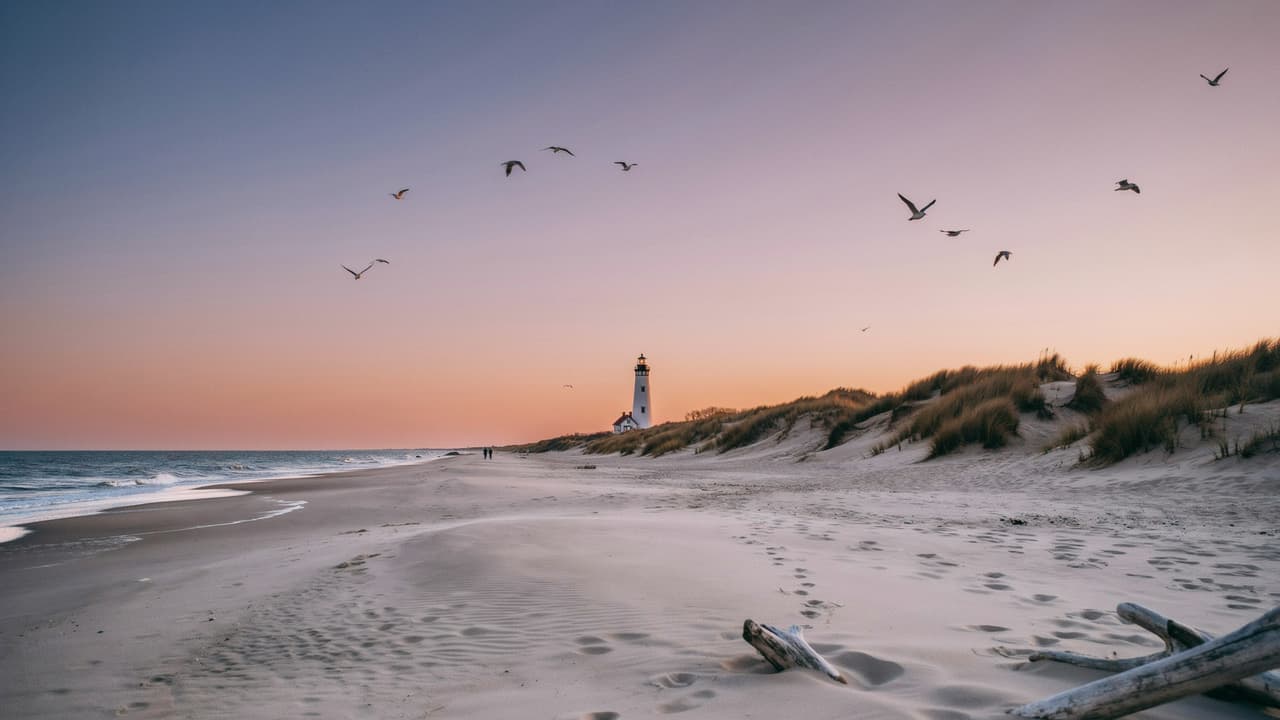
West Michigan is the sunset side of the state. Along the Lower Peninsula’s Lake Michigan shoreline, sandy beaches, forested dunes and working harbors sit a short drive from cities with plenty to do: art and presidential history in Grand Rapids, Dutch heritage in Holland, a lighthouse pier in Grand Haven, World War II ships in Muskegon, and an arts-town feel in Saugatuck.
Use this guide as your starting point. It explains how we define the region, compares the main towns side by side, and highlights what each one does best. It also decodes which beaches need a state park pass, lays out sample itineraries, and covers seasons, getting around and beach safety. When you are ready to go deeper, the town sections link to our full guides.
What Counts as West Michigan?
West Michigan has no official boundary. Locals most often mean the Grand Rapids–Muskegon–Holland area, and visitors often stretch the term to cover most of the Lower Peninsula’s Lake Michigan shoreline. Narrower definitions stick to the four counties at the region’s core (Allegan, Kent, Muskegon and Ottawa), while broader ones reach north toward Ludington and south toward Kalamazoo.
On InsideMichigan, we draw the line like this: West Michigan runs from Saugatuck-Douglas in the south to Ludington in the north, with Grand Rapids anchoring the interior. Everything from South Haven south to the Indiana border lives in our Southwest Michigan guide, which follows the three-county footprint (Berrien, Cass and Van Buren) used by the Southwestern Michigan Tourist Council. Heading farther up the coast? Start with Northern Michigan.
West Michigan at a Glance
| Best for | Lake Michigan beaches, dunes, lighthouses, museums, festivals and weekend getaways |
|---|---|
| Main hubs | Grand Rapids, Holland, Grand Haven, Muskegon, Saugatuck-Douglas, Ludington |
| Getting there | Gerald R. Ford International Airport (Grand Rapids); Amtrak’s Pere Marquette from Chicago; I-96, I-196, US-31 and US-131; seasonal ferries from Muskegon and Ludington to Wisconsin |
| Best seasons | Summer for swimming and shoreline events; spring and fall for festivals, fishing runs and quieter beaches |
| State park entry | Michigan Recreation Passport required for vehicles (details below) |
| Pairs well with | Southwest Michigan to the south, Northern Michigan to the north |
Which West Michigan Town Is Right for You?
Every town on this stretch of shoreline has a beach, but each has a different personality. Use this table to match the trip you want with the town that fits.
| Town | Best for | Don’t miss |
|---|---|---|
| Grand Rapids | Museums, gardens and a city-weekend base | Frederik Meijer Gardens & Sculpture Park; Gerald R. Ford Presidential Museum |
| Holland | Spring festival visits and a small-town downtown with a beach | Tulip Time; Holland State Park |
| Grand Haven | A classic summer beach-town trip | The pier and lighthouses; the Musical Fountain |
| Muskegon | Maritime history, big dunes and the Wisconsin ferry | USS LST 393; USS Silversides; P.J. Hoffmaster State Park |
| Saugatuck-Douglas | An arts-town atmosphere with dune scenery | The hand-cranked chain ferry; Oval Beach |
| Ludington | Camping, hiking and big-nature scenery | Ludington State Park; Big Sable Point Lighthouse |
Explore West Michigan Town by Town
Grand Rapids: Museums, Gardens and Big-City Energy
Grand Rapids is Michigan’s second-largest city, with about 199,000 residents at the 2020 census, and it makes the natural inland base for a West Michigan trip. Downtown, the Grand Rapids Art Museum, the Gerald R. Ford Presidential Museum, the Grand Rapids Public Museum and the Grand Rapids African American Museum & Archives sit close together, according to Experience Grand Rapids, which describes them as a 10-minute walk or a free bus ride from one another.
Ford grew up in Grand Rapids, and his gravesite is on the presidential museum’s grounds. Just outside town, Frederik Meijer Gardens & Sculpture Park has been a draw since 1995. Its mix of indoor theme gardens, outdoor gardens, trails and sculpture has earned national recognition, including a “best sculpture park” ranking from USA Today that Experience Grand Rapids highlights.
Good to know: Grand Rapids has the region’s main airport and daily Amtrak service to Chicago, which makes it the easiest West Michigan city to reach without a long drive. Read our Grand Rapids guide →
Holland: Tulips, Dutch Heritage and a Lakefront
Holland’s Tulip Time Festival began in 1929. It grew out of a 1927 proposal by Holland High School biology teacher Lida Rogers, who suggested adopting the tulip as the city’s flower to honor its Dutch heritage. The festival is run by a nonprofit and has been honored by the World Tulip Summit, including a lifetime achievement award in 2024. The 2027 festival is tentatively scheduled for April 30 to May 9, so confirm dates before you book.
Outside festival season, head to Holland State Park, which is split into two units: one on Lake Michigan and one on Lake Macatawa. Together they give you a beach, a view of boats moving through the channel, and one of the region’s best sunset spots.
Good to know: Amtrak’s Pere Marquette stops in Holland, so you can reach the Tulip City by train from Chicago or Grand Rapids. Read our Holland guide →
Grand Haven: Pier, Lighthouses and Coast Guard Pride
Grand Haven packs a lot into a walkable footprint: a state park beach beside the pier, red lighthouses at the end of it, a boardwalk along the Grand River, and a downtown just steps away. At night in summer, the Grand Haven Musical Fountain synchronizes water, light and music, as it has since 1962.
The town is also officially “Coast Guard City, USA,” a designation made by an Act of Congress and signed on November 13, 1998. Its Coast Guard Festival, a roughly 10-day celebration each summer, traces its roots to a 1924 picnic and rowing competition and now draws crowds in the hundreds of thousands, according to the festival’s own organizers. Come in September instead, and you may catch the annual Salmon Festival. For a quieter dune hike, locals recommend Rosy Mound Natural Area.
Good to know: Grand Haven State Park requires a Recreation Passport for vehicle entry. Expect heavy crowds during festival week. Read our Grand Haven guide →
Muskegon: Ships, Dunes and the Wisconsin Ferry
Muskegon is the region’s maritime capital. The USS LST 393 Veterans Museum is a restored World War II landing ship and one of only two of its kind left in the United States. The USS Silversides Submarine Museum (a real WWII submarine) and the SS Milwaukee Clipper, a National Historic Landmark, round out a ship-focused day.
For beaches, Muskegon State Park has more than two miles of Lake Michigan shoreline plus roughly a mile on Muskegon Lake, and Pere Marquette Park is a popular spot for watching freighters and ferries come through the channel. Just south, P.J. Hoffmaster State Park has dune trails, a dune climb stairway and the Gillette Sand Dune Visitor Center.
Good to know: The Lake Express high-speed ferry links Muskegon with Milwaukee in about 2.5 hours on a seasonal schedule, which makes Muskegon a popular door into or out of Wisconsin. Read our Muskegon guide →
Saugatuck-Douglas: Chain Ferry, Dunes and Oval Beach
Saugatuck is home to the Saugatuck Chain Ferry, which debuted in 1857 after a bridge over the Kalamazoo River washed out. The current ferry, Diane, was built in 1965 and is described by the Saugatuck-Douglas History Center as the last hand-cranked chain ferry in the United States. The short crossing lands near Mount Baldhead, a dune with a staircase of roughly 300 steps, and a trail on to Oval Beach.
Oval Beach opened in 1936, when a new road made it possible to drive to the lakeshore for the first time, and its oval parking lot gave it its name. The surrounding Saugatuck-Fennville area is also part of Southwest Michigan’s wine country, so a winery stop fits easily into a beach day.
Good to know: Oval Beach is a local beach with its own parking rules, so the state Recreation Passport does not apply there. Read our Saugatuck guide →
Ludington: Dunes, a Lighthouse and the Badger
Ludington State Park sits between Lake Michigan and 5,000-acre Hamlin Lake, according to the Michigan DNR. It has scenic dunes, three modern campgrounds, a rustic hike-in campground and 21 miles of marked trails. A 1.8-mile one-way path leads to the Big Sable Point Lighthouse, and you can walk or bike it. Seasonal interpretive programs and the restored Lake Michigan Beach House help explain the dune ecology and the area’s maritime and lumber-era history.
Out on the water, the SS Badger, a National Historic Landmark, makes the roughly four-hour crossing between Ludington and Manitowoc, Wisconsin. It is the last of the big Lake Michigan car ferries that once made Ludington a major ferry port.
From our trips: My family has spent many summers at Ludington State Park, swimming in both Hamlin Lake and Lake Michigan. Our favorite tradition is floating the Big Sable River. We put our tubes in just below the Hamlin Lake dam and drift about a mile through the park, all the way to the Lake Michigan beach. It’s my favorite Ludington adventure, and a big reason this is my favorite state park on Lake Michigan. Go early to get parking, and plan to spend at least a half day. The camp store also sells good Ludington sweatshirts.
Good to know: Most of Ludington State Park’s Lake Michigan shoreline is closed to pets to protect endangered piping plover habitat, though one pet-friendly beach is open. The Big Sable Point Lighthouse is open on a seasonal schedule, so check the Michigan DNR before you go. A Recreation Passport is required for vehicle entry. Read our Ludington guide →
West Michigan Beaches and State Parks, Decoded
One of the most common trip-planning mistakes is assuming every beach works the same way. Some West Michigan beaches are state parks that require a Recreation Passport for vehicle entry. Others are local beaches with their own parking and permit rules. Use this table as a starting point, and always check the park or city before you go.
| Beach or park | Near | Type | State pass needed? |
|---|---|---|---|
| Holland State Park | Holland | State park | Yes |
| Grand Haven State Park | Grand Haven | State park | Yes |
| P.J. Hoffmaster State Park | Muskegon area | State park | Yes |
| Muskegon State Park | North Muskegon | State park | Yes |
| Silver Lake State Park | Mears | State park | Yes |
| Ludington State Park | Ludington | State park | Yes |
| Pere Marquette Park | Muskegon | Local park | No (check local parking rules) |
| Oval Beach | Saugatuck | Local beach | No (check local parking rules) |
About the Recreation Passport: It grants vehicle entry to all 103 Michigan state parks and recreation areas, plus state forest campgrounds and boating access sites. For 2026, the Michigan DNR lists the passport at $15 for Michigan-registered vehicles when added during license plate renewal. Out-of-state vehicles pay $42 for an annual pass or $12 for a day pass. You do not need one if you arrive on foot or by bicycle. Prices can change, so confirm on the Michigan DNR website.
Three Sample West Michigan Itineraries
These routes follow the shoreline in one direction so you can drive them without backtracking. Check hours and seasonal schedules before you go.
The Classic Lakeshore Weekend (Holland, Grand Haven, Muskegon)
- Day 1: Start in Holland with a walk through downtown and an afternoon at Holland State Park. Drive north to Grand Haven for a pier walk at sunset and, in summer, the Musical Fountain after dark.
- Day 2: Head north, stopping at P.J. Hoffmaster State Park, which sits between Grand Haven and Muskegon, for the dune climb. In Muskegon, tour the USS LST 393 and finish with beach time at Pere Marquette Park or Muskegon State Park.
City Plus Shore (Grand Rapids and Saugatuck)
- Day 1: Spend the day in downtown Grand Rapids. Pick two or three of the museums within walking distance of each other, and save time for a stroll along the river.
- Day 2: Visit Frederik Meijer Gardens & Sculpture Park in the morning, then head to Saugatuck for the evening. Cross on the hand-cranked chain ferry.
- Day 3: Climb Mount Baldhead and spend the day at Oval Beach. On the way back, stop in Holland if you have time.
North Shore Nature Weekend (Ludington)
- Day 1: Hike or bike the 1.8-mile Lighthouse Path to Big Sable Point Lighthouse in Ludington State Park. Tour the lighthouse if the season allows.
- Day 2: Rent a canoe, kayak or paddleboard at the Hamlin Lake beach house, or spend the day on the Lake Michigan beach. If you want a taste of the Great Lakes’ maritime past, add a visit to the Port of Ludington Maritime Museum.
If It Rains
West Michigan has plenty of indoor options: the downtown Grand Rapids museum cluster, the indoor theme gardens at Meijer Gardens, the ship museums in Muskegon, and, in season, the exhibits at Ludington State Park’s Lake Michigan Beach House.
When to Go: A Season-by-Season Planner
| Season | What’s happening | Planning notes |
|---|---|---|
| Spring | Tulip Time in Holland (late April to early May); spring fishing runs along the Ludington shoreline | Book Holland lodging early for festival week |
| Summer | Beach season; Musical Fountain evening shows in Grand Haven; Coast Guard Festival in Grand Haven; seasonal lighthouse and ship tours | Busiest time on the shoreline; arrive early for parking |
| Fall | Salmon Festival in Grand Haven (September); fall fish runs at Ludington; quieter beaches | Some seasonal attractions close in October, including the Ludington Beach House after mid-October |
| Winter | Shoreline walks and city museums | Many seasonal attractions are closed, including the Big Sable Point Lighthouse after October |
Getting to and Around West Michigan
- By air: Gerald R. Ford International Airport (GRR) in Grand Rapids is the region’s main airport.
- By train: Amtrak’s Pere Marquette runs between Chicago and Grand Rapids and serves Holland. Local travel from the station is easiest with a car or rideshare.
- By road: I-96 runs from Muskegon through Grand Rapids to Lansing. I-196 connects Grand Rapids and Holland with the southwest corner of the state and meets I-94 near Benton Harbor. US-31 follows the lakeshore, and US-131 runs north–south through Grand Rapids.
- By ferry: The Lake Express runs between Muskegon and Milwaukee, and the SS Badger runs between Ludington and Manitowoc. Both operate seasonally, so check schedules before planning around them.
Beach and Pier Safety on Lake Michigan
The Great Lakes have no tides, but they do have strong currents. The National Weather Service and Michigan Sea Grant warn that rip currents and currents near piers (called structural currents) can be extremely dangerous, and Lake Michigan has had more fatalities from dangerous nearshore currents than any other Great Lake. West Michigan’s piers are major attractions, so keep these basics in mind:
- Check the National Weather Service’s Great Lakes beach hazard forecast and the flag warning system before you swim.
- Stay out of the water around piers, breakwalls and river outlets, and avoid walking on piers when the surf is high.
- Set up your beach spot away from piers.
- If you are caught in a rip current, do not fight it. Swim parallel to the shore until you are free.
West Michigan FAQ
What is West Michigan?
There is no official definition. The term most commonly means the Grand Rapids–Muskegon–Holland area and, more broadly, much of the Lower Peninsula’s Lake Michigan shoreline. On InsideMichigan, it runs from Saugatuck-Douglas north to Ludington.
How many days do you need in West Michigan?
A long weekend covers one or two hubs and their nearby beaches. If you want to combine Grand Rapids with several lakeshore towns, plan on four to five days.
What are the best beaches in West Michigan?
Popular choices include Holland State Park, Grand Haven State Park, Muskegon State Park, Pere Marquette Park, Oval Beach in Saugatuck and Ludington State Park. The right one depends on whether you want dunes, a pier walk, amenities or quiet.
When is Tulip Time in Holland?
The 2027 festival is tentatively scheduled for April 30 to May 9. Confirm dates on the official Tulip Time website before you book.
Do I need a pass for Michigan state parks?
Yes, a Recreation Passport is required for vehicle entry to state parks and recreation areas. It is not required if you arrive on foot or by bicycle. Local beaches have their own parking rules.
Can I take a ferry from West Michigan to Wisconsin?
Yes. The Lake Express links Muskegon and Milwaukee in about 2.5 hours, and the SS Badger links Ludington and Manitowoc in roughly four hours. Both run on seasonal schedules.
Can I visit West Michigan without a car?
You can reach Holland and Grand Rapids by Amtrak, but beaches, state parks and smaller towns are much easier to explore with a car.
How is West Michigan different from Southwest Michigan?
On InsideMichigan, West Michigan covers the shoreline and inland cities from Saugatuck-Douglas north to Ludington. Southwest Michigan covers the Berrien, Cass and Van Buren county area, including St. Joseph, South Haven and New Buffalo. See our Southwest Michigan guide.
Keep Planning
- Southwest Michigan: Dunes, Beach Towns and Wine Country
- Northern Michigan Travel Guide
- All Michigan Destinations
Sources and Further Reading
We build these guides from official and primary sources wherever possible. Details like hours, prices and festival dates change, so confirm them with the sources below before you go.
- Michigan DNR: Ludington State Park
- Michigan DNR: Ludington State Park programs and hours
- Michigan DNR: Recreation Passport
- Tulip Time Festival
- Experience Grand Rapids: Museums
- Visit Muskegon: Maritime Heritage
- USS LST 393 Veterans Museum
- Saugatuck-Douglas History Center: Chain Ferry
- Saugatuck-Douglas History Center: Beaches
- Grand Haven Coast Guard Festival
- National Weather Service: Great Lakes Safety
- Michigan Sea Grant: Dangerous Currents
- West Michigan Tourist Association